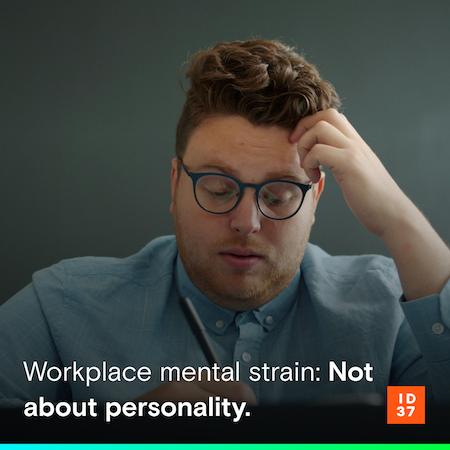
Workplace mental strain rarely stems from a single cause. In most cases, it develops when job demands and available resources remain out of balance over an extended period. Many organizations understand this. Yet workplace health initiatives are often fragmented - a stress management workshop here, a resilience seminar there. What is often missing is an individualized approach that translates general health initiatives into practical support for each employee's daily work.
This is where ID37's AI coach Jay makes a difference. Built on each user's individual ID37 personality profile, Jay helps employees understand challenging situations, recognize their personal resources, and identify practical next steps they can apply immediately.
At a glance:
- Workplace mental strain is usually caused by organizational conditions rather than individual stress sensitivity.
- Employee well-being initiatives are far more effective when they are tailored to the individual and their specific work situation.
- Sustainable workplace mental health requires an integrated approach that combines leadership, personal development, work design, and measurable outcomes.
- AI Coach Jay understands each user's individual ID37 Personality Profile and provides personalized support in everyday work situations.
- Transparency, voluntary participation, strong privacy standards, and clear personal value are essential for employee acceptance of digital coaching tools.
What is workplace mental strain?
Workplace mental strain includes all psychological influences employees experience while performing their work. These include workload, time pressure, interruptions, interpersonal conflict, leadership behavior, unclear responsibilities, and limited decision-making authority.
Mental strain is not inherently negative. Challenging work can foster growth, stimulate learning, and increase motivation. Problems arise when demands consistently exceed available resources, instructions become contradictory, or employees lack the support they need to succeed.
Chronic overload develops when employees are expected to perform at a high level while receiving insufficient support, autonomy, or opportunities for recovery.
People also experience workplace demands differently. What motivates one employee may overwhelm another. Even insufficient challenge can become a source of stress when employees lose opportunities for growth, purpose, and meaningful contribution.
Organizations that prioritize employee well-being design work environments that align with individual needs. This creates the foundation for long-term engagement, resilience, and sustainable performance.
Why should mental health be a business goal?
Mental strain often becomes visible only when employees become ill. Yet the warning signs appear much earlier: in meetings that create pressure instead of psychological safety, in roles that seem clearly defined on paper but become increasingly blurred in everyday work, and in tasks that challenge employees while gradually pushing them beyond their limits.
Healthy work is created when the work environment, the job itself, and the individual fit together. Providing isolated stress management programs is not enough. Employee well-being requires a systematic approach—one that is strategically embedded within the organization while also being experienced in everyday work.
The results are measurable: fewer sick days, lower employee turnover, and more stable teams. Investing in mental health protects employees while strengthening the organization.
How can companies develop mental health at work?
Health initiatives lose their impact when they are not strategically embedded or fail to address employees' everyday reality. Workplace health management becomes effective when it changes concrete situations rather than remaining a collection of isolated initiatives.
1. Improve work design
The most effective form of prevention is the design of the work itself. No tool can permanently compensate for unrealistic workloads, conflicting goals, or ineffective processes. However, digital support can reveal where employees repeatedly encounter the same obstacles. These insights should feed back into leadership, teamwork, and organizational development.
2. Empower leaders
Leadership is one of the strongest drivers of workplace mental health because employees experience it every day. Leaders set goals, allocate work, provide feedback, and shape whether employees feel safe talking about excessive workload or other challenges.
Employee well-being belongs on every leader's agenda - not as an additional responsibility, but as an integral part of effective leadership.
3. Create development opportunities for all employees
The most effective form of prevention remains the design of the work itself. No tool can permanently compensate for unrealistic workloads, conflicting goals, or poor processes. But tools can make visible where people repeatedly run into the same limits. These insights should flow back into leadership, teamwork, and organizational development.
4. Measure and manage progress
Workplace mental health deserves management attention. Metrics such as employee satisfaction, turnover, absenteeism, and perceived autonomy provide valuable insights. Tools such as an Employee Satisfaction Index can help organizations monitor progress. What matters most, however, is what happens after the measurement. Results only create value when they are translated into concrete actions.
How does AI coaching support employees in their daily work?
ID37 is built on scientifically validated personality profiles, enabling truly personalized support. AI Coach Jay helps leaders, employees, and teams understand workplace challenges through the lens of individual motives and reflect on them before they escalate.
The foundation is the ID37 Personality Analysis with its 16 Life Motives. It identifies which working conditions are likely to promote well-being and which may create discomfort. Particularly high or low motive scores can point to potential stressors, such as limited autonomy, unclear structures, or insufficient social interaction.
Practical Examples
- Lead more effectively
Most leaders know they should communicate more clearly, show greater appreciation, and adapt their leadership style to individual employees. The greater challenge is knowing what that means for a specific employee, in a particular conversation, and in a real-life situation.
Jay helps leaders prepare for and reflect on employee conversations, better understand individual needs, and translate personality insights into practical leadership decisions. What kind of clarity does this employee need? How should feedback be delivered? Where is additional structure helpful, and where would greater autonomy lead to better results? This transforms personality insights into practical leadership.
- Resolve conflicts early
Many workplace conflicts begin with assumptions. “She keeps asking detailed questions” becomes “She doesn’t trust me.” “He makes decisions quickly” becomes “He ignores everyone else.” Different working styles quickly turn into judgments about someone’s character.
Jay encourages teams to question these assumptions. Differences in motives, needs, and working styles become visible and easier to understand. With the consent of everyone involved, individual personality profiles can also be considered. This helps teams recognize recurring patterns, blind spots, and sources of friction before they develop into larger conflicts.
- Regain your sphere of influence
People who spend all day reacting to events often lose their sense of engagement and personal effectiveness. Meetings appear unexpectedly, priorities constantly shift, and planned work gets pushed aside.
Jay helps employees regain clarity about what they can actually influence.This is where AI Coach Jay provides its greatest value - helping people focus on what they can influence instead of feeling overwhelmed by everything they cannot.
- What can I resolve myself?
- Which boundary do I need to set?
- Which decision is not mine to make?
- What support do I need from my manager or my team?
How is acceptance of digital tools built?
The more personalized digital support becomes, the more important transparency, voluntary participation, and data protection become. In the workplace, a digital tool must never become - or even appear to become - a tool for monitoring employee performance.
Employees need to understand which data is collected, who has access to it, and how it is used.
Before introducing digital tools, organizations should provide clear answers to the following questions:
- Which data is collected?
- Who can access which information?
- Is use voluntary?
- Will user input be used for performance evaluation?
- Can users delete their data?
- Is the tool managed by HR, or does each employee remain in control?
At ID37, participation is always voluntary. Users retain full control over their personality analysis and their personal data. Information is never shared with third parties and is not used to train AI models.
All ID37 services comply with the General Data Protection Regulation (GDPR) and are hosted exclusively in secure data centers located in Germany.
Where are the limits of an AI coach?
An AI coach can support self-reflection and help employees apply new insights in their daily work, but it cannot solve structural workplace problems or replace medical or psychotherapeutic care. If excessive workload, poor leadership, or ineffective processes are making employees ill, the organization - not the AI - must take action.
Human coaches remain essential for deeper personal development, complex organizational change, and situations involving significant psychological strain. Ideally, organizations work with certified ID37 Masters, who introduce Jay to teams and guide the implementation process.
AI coaching is designed to complement everyday work—not to replace effective leadership, personal responsibility, or professional support.
Conclusion: Mental health requires individual support
Workplace mental health develops when organizations take responsibility for creating healthy working conditions and ensure that employees are not left to manage daily challenges on their own.
AI Coach Jay helps bridge the gap between insight and action. It enables employees to apply what they have learned at the moment it matters most, helping them build new habits, make better decisions, and respond more consciously to workplace challenges.
Personalized AI coaching does not replace organizational responsibility. Instead, it complements good leadership, thoughtful work design, and a healthy workplace culture by providing practical, individualized support every day.
Frequently asked questions
- What is mental strain at work?
Companies can reduce strain by clarifying roles, designing work realistically, improving leadership, addressing conflicts early, and strengthening autonomy. Isolated stress-management offerings are rarely enough. What works is a systematic approach that connects work design with individual action. - How can companies reduce mental strain?
Companies reduce stress by clarifying roles, designing work realistically, improving leadership, addressing conflict early and strengthening room for action. Individual stress programs are rarely enough. A systematic approach that connects work design and individual action is more effective. - How can companies reduce mental strain?
Jay supports employees through guided reflection during everyday work. Based on each person’s individual ID37 personality profile, the AI coach helps users better understand workplace situations, recognize recurring behavioral patterns, and prepare practical next steps - for example before feedback conversations, conflicts, or important decisions.
Further reading: The article "How AI-powered coaching makes personal development more effective" shows how personalized, AI-supported soft-skill development closes the transfer gap.
Photo by Vitaly Gariev on Unsplash