Collaboration

How to Resolve Team Conflicts: 5 Steps That Actually Help

Written by
Cornelia Kirschke
|
11/6/2026
Resolving team conflicts means managing your own behavior
Resolving team conflicts means managing your own behavior, not trying to change others

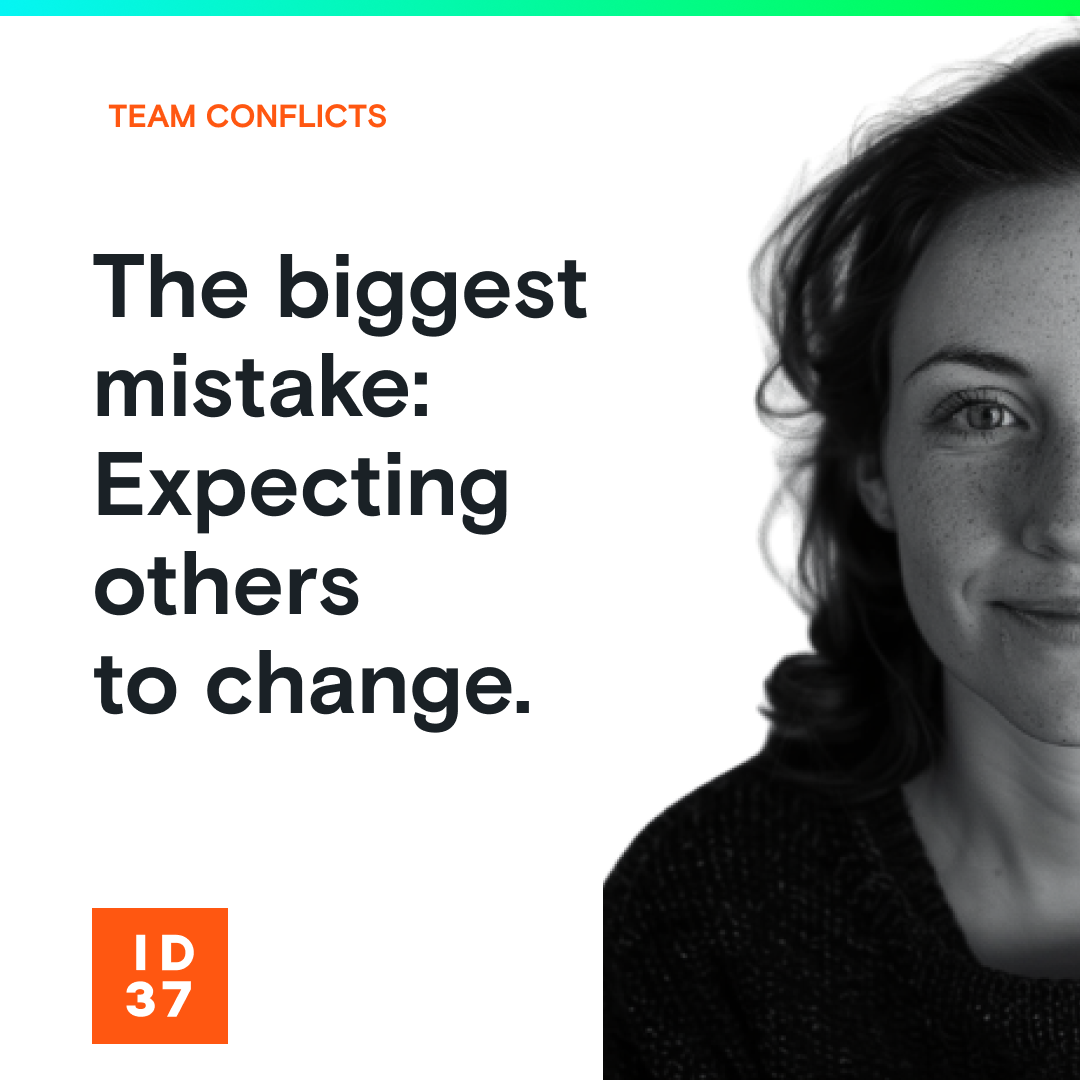
The biggest mistake people make when dealing with conflict? Expecting the other person to change.

What you can change is your own behavior: the words you choose, when you speak up, and how you prepare for difficult conversations.

Many workplace conflicts appear to be about facts, decisions, or disagreements. But the real tension often lies beneath the surface, in how people relate to one another. Personality differences can help explain why the same comment barely registers with one person but hits a nerve with another.

Key Takeaways:

  • Resolving team conflicts starts with understanding the situation and managing your own behavior.
  • A disagreement turns into a conflict when personal values, needs, or someone's sense of identity are challenged.
  • Understanding what motivates people helps explain why they think, feel, and act differently in the same situation.
  • The ID37 personality assessment reveals individual motivations, while the ID37 team analysis highlights similarities and differences within a team.
  • Jay, the AI coach, helps you prepare for challenging conversations and practice realistic conflict scenarios.

Why trying to change other people doesn't work

Personality is relatively stable. Behavior, however, is flexible to a certain degree.

How we perceive others often says as much about us as it does about them. We can question our interpretations of someone else's behavior, challenge our assumptions, and consciously choose how we respond.

„Trying to change other people is an almost hopeless undertaking. Failure is practically inevitable.“ – Thomas Staller, Managing Partner at ID37 Company

Conflict itself isn't necessarily destructive. Wherever people work together, disagreements are inevitable. The real problem begins when people can no longer openly discuss their different perspectives and interests.

So the question isn't what the other person can do, but rather: "What can I do to make a constructive conversation possible again?"

That shift in perspective is often the first step toward resolving a conflict.

How to resolve team conflicts: 5 steps to a constructive conversation

When tensions rise, a structured approach can help turn a difficult situation into an opportunity for understanding.

  1. Identify the conflict clearly. What actually happened? Separate what you observed from how you interpreted it. Focus on specific behaviors rather than assumptions about someone's intentions.
  2. Understand your own reaction. Why did the situation affect you? Which personal need, value, or motivation might have been challenged?
  3. Consider the other person's perspective. What might be driving their behavior? Which needs or motivations could explain their response?
  4. Prepare for the conversation. Describe what you observed, explain how it affected you, and communicate what you would like to change. Ask open-ended questions to understand the other person's perspective.
  5. Agree on concrete next steps. Work together to define what each person will do differently going forward. Make the agreement specific enough to put into practice.

These steps won't resolve every conflict. But they create the conditions for a more productive conversation, especially when both sides are willing to participate.

When does a disagreement become a conflict?

A disagreement becomes a conflict when something personally important is at stake: a need, a value, a belief, or someone's sense of identity.

Two people can hear exactly the same statement and experience it in completely different ways. That's because their personal needs, values, and past experiences shape how they interpret what is being said.

As communication theorist Paul Watzlawick famously observed:

„Every communication has a content and relationship aspect, such that the latter classifies the former and is therefore a metacommunication.“ – Paul Watzlawick, Janet H. Beavin, Don D. Jackson

In other words, communication is never just about the information being exchanged. The relationship between the people involved influences how that information is received.

This explains why workplace conflicts often remain stuck in endless debates about facts or decisions, while the underlying emotional tension goes unaddressed.

Without understanding what motivates the people involved, feedback can feel like criticism, disagreement can seem like rejection, and a simple objection can be perceived as a personal attack.

Why people react differently to conflict

Motivations are the internal drivers behind our behavior. They influence what matters to us, what we avoid, and what triggers an emotional response.

ID37 measures 16 life motives, capturing the unique strength of each motivation within an individual. Rather than assigning people to fixed personality types, it creates a differentiated picture of what drives them.

Learn more: What is a personality test?

Consider a simple example.

Two colleagues receive the same critical feedback.

Someone with a strong need for Social Acceptance may experience the feedback as personal rejection or a sign that they are not valued.

Someone with a lower need for Social Acceptance may view the exact same feedback as useful information and an opportunity to improve.

Neither reaction is inherently right or wrong. They reflect different underlying needs, not differences in character or competence.

This distinction matters in conflict resolution.

Personality assessments that categorize people into rigid types can unintentionally reinforce labels such as "difficult," "overly sensitive," or "controlling."

A more differentiated approach helps people understand the motivations behind behavior without reducing individuals to a fixed personality category.

For a deeper look at this topic, read: How much can personality change?

How can personality profiles help resolve workplace conflicts?

The ID37 personality assessment helps people understand what drives them, what causes stress, and why they respond the way they do. The results are nonjudgmental. There are no good or bad motivations, only individual differences.

For conflict resolution, three questions are particularly valuable:

  1. Which situations tend to trigger strong emotional reactions in me?
  2. How do I typically respond when those situations arise?
  3. What underlying needs might explain the other person's behavior?

Understanding your own motivational profile helps you recognize your triggers. Understanding someone else's profile can help you interpret their behavior more accurately.

The ID37 Team Analysis takes this understanding to the team level. It visualizes individual motivational profiles, revealing similarities, differences, and patterns that shape team dynamics.

What looks like intentional provocation may actually stem from conflicting motivational needs.

Of course, understanding these differences doesn't automatically resolve a conflict. Both parties still need to be willing to work toward a solution.

A realistic example: Two team leaders, one recurring conflict

The situation

Two team leaders regularly present their work to their shared manager.

During these presentations, Team Leader A repeatedly interrupts Team Leader B.

Team Leader B becomes increasingly frustrated. Tensions build, and the risk of an open confrontation grows.

What's driving the conflict?

Different motivational needs may help explain the situation.

Team Leader A might have strong motivations for INFLUENCE or STATUS. Being in control of the discussion or making a strong impression in front of management may be particularly important to them.

Team Leader B, meanwhile, might have a strong need for AUTONOMY. Being interrupted in front of their manager may feel like an intrusion on their independence or a violation of personal boundaries.

From Team Leader A's perspective, speaking up may feel perfectly natural.

From Team Leader B's perspective, the same behavior may feel disrespectful or undermining.

Neither person necessarily intends to create conflict. Yet their different motivations can turn an ordinary presentation into a recurring source of tension.

How can they resolve it?

Instead of retaliating during the next meeting, Team Leader B initiates a conversation afterward.

They describe what happened, explain how the interruptions affected them, and use their ID37 profile to clarify why the situation triggered such a strong reaction.

Together, the two team leaders explore Team Leader A's perspective as well, using their motivational profiles to better understand each other's needs.

They then agree on a simple rule for future presentations:

Each person gets to finish speaking before the other adds comments or suggestions.

The result is more than a better understanding of personality differences. It's a concrete agreement that improves how they work together.

The important takeaway: Motivations don't explain every conflict. But understanding them can help people interpret each other's behavior more accurately and respond more constructively.

Prepare for difficult conversations with Jay, the AI Coach

Jay uses motivational profiles stored and shared within the ID37 system to help people prepare for challenging conversations.

Let's return to the example of the two team leaders.

Before approaching Team Leader A, Team Leader B can use Jay to prepare for the conversation.

If both team leaders have shared their motivational profiles, Team Leader B can reference Team Leader A directly in the chat by typing @.

Jay can then use the relevant profiles to help structure the conversation, develop neutral questions, and find constructive ways to express concerns.

Two capabilities make Jay particularly useful for conflict resolution:

  • Work with real people and their motivational profiles. When colleagues have mutually agreed to share their profiles, they can be referenced directly in Jay's chat using @. Jay helps explore how the motivations of specific individuals might interact, complement each other, or create tension.
  • Practice real workplace conflict scenarios. Jay helps users prepare for difficult conversations and practice through realistic role-playing exercises. Whether you're planning to give feedback to a colleague or address tension in an upcoming meeting, you can work through the specific situation before having the actual conversation.

This makes it easier to experiment with different approaches, anticipate possible reactions, and communicate more thoughtfully.

Jay isn't a replacement for a human coach. Instead, it provides practical support for applying personality insights to everyday workplace situations.

Learn more about its capabilities and limitations: What is Jay, the AI coach?

Frequently Asked Questions about team conflict resolution

  • Can you resolve a conflict without the other person changing?
    Not always. You can influence the situation by changing your own behavior, reducing tension, and opening the door to a constructive conversation. However, lasting conflict resolution usually requires both parties to be willing to work toward a solution.
  • How is ID37 different from personality type tests?
    Traditional personality type assessments group people into predefined categories. ID37 takes a different approach by measuring 16 life motives as individual motivational strengths. This provides a more nuanced understanding of personality and reduces the risk of labeling someone as a "difficult personality type."
  • How does Jay include real people in conflict preparation?
    Jay uses the ID37 network feature. When two people have mutually agreed to share their motivational profiles, those profiles can be referenced in the chat using @. This allows Jay to explore the motivational dynamics between real colleagues and support preparation for specific conversations. Profiles cannot be included without the required consent.
  • Can a personality assessment replace coaching?
    No. Personality assessments and coaching serve different purposes. An assessment helps explain underlying motivations and behavioral patterns. Coaching supports personal development and behavioral change. Jay helps bridge the gap by making personality insights easier to apply in real situations, particularly when working with a human coach isn't an option.

Other Content

AI coach Jay supports coaching and self-coaching
Coaching

How does AI support coaching and self-coaching?

In this interview, Thomas Staller explains how the ID37 AI coach Jay uses personality profiles to enable individualized coaching and better team leadership.
26 Jul
2025

How does AI support coaching and self-coaching?

Leadership

Self-regulation: Leading consciously rather than reactively

Why discipline fails under stress – and how leaders use self-regulation, the ID37 profile and AI coach Jay to lead consciously instead of reactively.
4 Jun
2026

Self-regulation: Leading consciously rather than reactively

Personality tests measure personality
Psychology

What is a personality test?

Type-based or trait-based? What personality tests can do, where the differences lie and why science recommends trait-based tests like ID37.
13 Nov
2023

What is a personality test?

FAQs

Questions and Answers

What is the ID37 personality assessment?

The ID37 personality assessment is a scientifically validated test that measures 16 life motives. These motives drive our behavior – unconsciously and throughout our lives. The assessment generates an individual personality profile that reveals what truly motivates you. Unlike typology tests, ID37 does not categorize people into boxes but instead maps each person's unique motive structure. The result: deep self-understanding and targeted personal development. The ID37 personality assessment is successfully used in coaching, leadership development, HR diagnostics and personal orientation.

→ Take the ID37 personality test
→ Watch the 4-minute explainer video (English subtitles)

What is AI Coach Jay and how does it support personality development?

AI Coach Jay is a specialized chatbot that combines the scientifically validated ID37 personality assessment with generative artificial intelligence to enhance soft skills and people knowledge. It leverages each user's individual motive structure to deliver personalized prompts for self-reflection and personal growth. Users don't need to manually describe their character traits – Jay directly accesses the stored ID37 profile to provide relevant answers and conduct meaningful coaching dialogues. This makes personality development accessible, immediate and tailored to each individual's unique psychological makeup.

→ Blog article about AI Coach Jay
→ AI Coach Jay explainer video (English subtitles)
→ More ID37 FAQs

What are life motives and how do they influence personality?

Life motives are fundamental inner drivers that determine why people act, feel, and think the way they do. Psychology distinguishes 16 universal life motives – including curiosity, autonomy, social acceptance, and influence. Every person possesses all 16 motives, but in varying degrees. This individual combination shapes personality like a unique fingerprint. Unlike personality types (such as MBTI), life motives reveal the deeper needs that govern behavior over the long term. They are scientifically measurable and help in understanding one's own motivation. A detailed explanation of common psychological terms related to personality and motivation can be found in the ID37 Glossary.
‍
→ Discover the Psychology Glossary

Which 16 life motives does ID37 measure?

ID37 analyzes 16 fundamental life motives. Each motive describes a basic need that drives behavior.

The 16 life motives at a glance:

  • Curiosity: Desire for knowledge, insight and intellectual challenges
  • Social Acceptance: Desire for affirmation and acceptance from others
  • Influence: Desire for control and influence over people and processes
  • Status: Desire for prestige and a prominent position in society
  • Retention: Efforts to acquire and preserve possessions and other resources
  • Autonomy: Desire for independence from the expectations and influence of others
  • Social Participation: Desire for social interaction and contact with other people
  • Principles: Desire for conformity with the social norms of a particular social group or society as a whole
  • Social Engagement: Commitment to those who are suffering or disadvantaged, as well as to a more just society
  • Structure: Desire to structure one's surroundings in simple and consistent terms
  • Safety: Desire for a quiet and secure life
  • Revenge: Desire for retribution for any injustice experienced
  • Physical Exercise: Desire for movement and physical activity
  • Food Enjoyment: Desire for enjoyable experiences in association with food intake
  • Family: Desire to cultivate a caring and tight-knit familial network
  • Eros: Desire for sensual, erotic experiences and an active, fulfilled sex life

The individual expression – high, average or low – explains why people act and react differently.

→ Watch the 4-minute explainer video (English subtitles)
→ Explore the Psychology Glossary
→ Learn more in the ID37 Book

What makes AI Coach Jay different from conventional chatbots?

The key difference lies in the depth of analysis based on the 16 life motives. While standard AI systems provide generic responses, Jay generates highly individualized recommendations by considering the specific motive profiles of all parties involved – provided they have given consent. As a proprietary development by ID37, Jay combines psychological depth with the ability to conduct natural, fluid coaching conversations. All dialogue histories are stored in the user's ID37 account and can be accessed at any time. Jay functions as a digital expert capable of precisely interpreting complex personality dynamics and their effects on behavior, decisions and relationships.

→ Blog article about AI Coach Jay
→ AI Coach Jay explainer video (English subtitles)

What does my ID37 personality profile reveal about me?

The ID37 personality profile displays the expression of the 16 life motives – ranging from high to average to low. It explains what drives a person, what gives them energy and what they avoid. The profile makes visible why a person reacts the way they do in certain situations. It does not categorize but maps the unique motive structure, makes needs understandable and enables individuals to work on their development in a targeted manner.

→ Watch the 4-minute explainer video (English subtitles)

How does AI Coach Jay help leaders and teams improve collaboration?

Jay supports leaders in fulfilling their role more consciously by preparing them for difficult conversations and providing guidance on optimal wording and structure. Through the analysis of team profiles, Jay helps reduce tensions and strengthen feedback competence as well as emotional intelligence across all team members. This fosters sustainable team culture and performance while improving collective judgment in complex decision-making situations. Leaders gain actionable insights into team dynamics, communication preferences and potential friction points – enabling more effective management and stronger interpersonal relationships.

→ Chat-based examples for leadership and team development

How can I apply my ID37 profile in everyday life?

The ID37 profile serves as an individual compass for decisions. It forms the foundation for effective self-direction, emotion regulation and personal development. The ID37 profile specifically supports:

1. Self-awareness and goal setting: Through knowledge of the 16 life motives and their individual expressions, each person recognizes what truly matters to them in life. It shows where a person is intrinsically motivated and can consistently perform at their best with ease.

2. Emotion and stress management: With their ID37 profile, individuals learn to recognize their emotional patterns and identify trigger points. This enables them to anticipate and regulate emotions, break out of stimulus-response patterns and create space for finding solutions.

3. Relationships and conflict resolution: Self-awareness based on motives helps understand why other people are different. This understanding helps avoid and resolve conflicts and shape relationships harmoniously. The success factor: accepting others as they are.

4. Managing perception: The ID37 profile makes "blind spots" visible – the characteristics a person does not perceive in themselves.

The AI coach supports profiled individuals in training their soft skills based on real psychometric data.

→ Watch the 4-minute explainer video (English subtitles)

How can I involve colleagues or team members in consultations with Jay?

Users can connect with colleagues, coaches or family members within their ID37 account under "My Network". Once profiles are mutually shared, they can easily be included in the chat using the @-symbol. On this basis, Jay can analyze relationships, provide concrete tips for successful conversations or facilitate real conversation simulations and role-plays. This collaborative feature transforms Jay from a personal coach into a powerful tool for improving interpersonal dynamics, preparing for challenging discussions and developing stronger professional relationships based on mutual understanding of each other's motivational drivers.

→ AI Coach Jay explainer video (English subtitles)
→ Blog article about AI Coach Jay

Is ID37 scientifically validated?

Yes, ID37 is based on modern test development and meets high psychometric standards. The method was developed at the University of Luxembourg. It utilizes current findings from motivational psychology and personality research. Unlike outdated typologies such as MBTI or DISC, ID37 explains the causes of behavior – not just its surface. The quality criteria of objectivity, reliability and validity are scientifically documented.

→ Download the scientific manual (currently available in German; English translation forthcoming)

What benefits does AI Coach Jay offer for professional coaches and HR managers?

For professionals, Jay serves as an evidence-based sparring partner for designing coaching sessions and preparing analysis conversations. Jay does not replace human coaches or consultants – rather, it strengthens their work by providing a precise factual foundation and support for interpreting motive constellations or reflecting on complex relationship dynamics. In talent development, Jay helps accompany individuals more personally and align role requirements with employees' intrinsic motivation structures. HR managers benefit from deeper insights into team composition, succession planning and creating development paths that truly resonate with each person's core drivers.

→ Chat-based examples for leadership and team development

How does ID37 differ from other personality tests?

ID37 does not categorize. While MBTI or DISC force people into categories, ID37 shows the individual motive structure on a continuous scale. The test explains causes: Why does someone behave this way? Other tests only describe how someone behaves. ID37 is also based on current scientific research rather than outdated theories. The test was scientifically developed, validated and normed at the University of Luxembourg and meets all psychometric quality criteria. The result is precise, meaningful and easy to understand. In professional applications, users are guided by certified ID37 Masters – for maximum quality and responsible interpretation. Additionally, the AI coach can be used to interpret the personality profile.

→ Explore terms in the Glossary
→ Watch the 4-minute explainer video (English subtitles)
→ Watch the AI Coach Jay explainer video (English subtitles)

How secure is my personal data when using AI Coach Jay?

Data protection and security are ensured through data storage on AWS servers in Germany and strictly GDPR-compliant data processing. Before data is transmitted to the LLM for language processing, consistent pseudonymization takes place within the ID37 environment, removing any personal reference. Personal data and profiles are not used for training the artificial intelligence. Users retain full data ownership. ID37 Company prioritizes privacy at every level – your personality profile and all chatbot-relevant data remain securely stored in the protected ID37 environment, giving you complete control over your sensitive information.

→ ID37 Privacy Policy

How does the ID37 test differ from online quick tests?

The ID37 test differs significantly from online quick tests through its scientific foundation and measurement precision. Its quality criteria are transparently disclosed and enable reliable predictions of future behavior. The results serve as dependable orientation in life. ID37 also meets high standards for data protection (GDPR), voluntariness, non-discrimination and consulting ethics. The accompanying services and features of the ID37 platform are also unique.

Online quick tests, by contrast, are usually not validated, work without norm samples, roughly categorize people into types and are more entertaining than diagnostically reliable.

→ Download the scientific manual (currently available in German; English translation forthcoming)
→ Read the blog article about personality tests

What does AI Coach Jay cost and is there a free trial?

Access to AI Coach Jay costs 5 euros per month (plus VAT). To experience the benefits of the AI coach without commitment, ID37 Company offers a 14-day free trial period. The goal is to make this form of professional support accessible to a broad audience in both professional and personal contexts. The only requirement is having an existing ID37 personality profile. Payment is processed via credit card or PayPal, and corporate billing options are available. This affordable pricing democratizes access to personalized personality coaching that was previously only available through expensive one-on-one sessions.

→ Take the ID37 personality test

How does the ID37 personality test work?

The test taker completes an online questionnaire consisting of 144 self-descriptive statements about everyday behaviors, attitudes and habits. The algorithm calculates the expression across all 16 life motives and generates the ID37 personality profile and interactive analysis report, which explains what the expressions mean. Additionally, the AI coach can be used for profile interpretation. It works on the basis of individual motive profiles and is trained on the ID37 model. For maximum quality and responsible interpretation, test takers book an analysis session with an ID37 Master.

→ Take the ID37 personality test
→ Find an ID37 Master

How long does the ID37 test take?

Completing the ID37 personality test takes approximately 25–30 minutes. This can be done conveniently on a computer, tablet or smartphone. Interruption is possible – progress is saved. For meaningful results, test takers should complete the test in a quiet environment without distractions. When questions are answered spontaneously, without overthinking, an authentic and honest personality profile is generated.

→ Take the ID37 personality test

How much does the ID37 personality test cost?

The ID37 personality test currently costs €119 including VAT. This includes the online questionnaire, the interactive analysis report, lifetime access to the personality profile and the services and tools on the ID37 platform. Additional services such as a personal analysis session with an ID37 Master or the AI coach are optionally available. The ID37 AI coach currently costs €5 per month, plus VAT. Payment is made via PayPal or credit card. Special conditions are available for teams and companies.

→ Purchase the test on id37.io
→ Learn more about the AI coach

How secure is my data with ID37?

ID37 stores all data in data centers in Germany (AWS Cloud Germany). Transmission is encrypted. All personality data remains confidential and is not shared with third parties. All users decide for themselves what happens with their data and whether and with whom they share their profile. ID37 complies with GDPR requirements. Data protection has the highest priority – your personality remains your private matter.

→ Read the ID37 Privacy Policy

How often should I take the ID37 test?

Once is usually sufficient. The 16 life motives are largely stable. Personality stabilizes in its fundamental features in early childhood and remains largely constant from adolescence onwards. The high reliability and contemporary, valid norming of the ID37 test procedure are based on this assumed stability over longer periods. Repeating the test may be useful after significant life events. The test measures not moods but fundamental drives.

In short: The profile remains meaningful long-term, even when behavior and circumstances change.

→ Take the ID37 personality test

Who is the ID37 personality assessment suitable for?

ID37 is suitable for anyone who wants to better understand themselves and others. Individuals use the test for self-reflection and personal development. Teams analyze their collaboration and resolve conflicts. Leaders learn to guide employees individually. Coaches and consultants use ID37 as part of their professional work. Using the tool, they can conduct a precise assessment of their clients' current situation and develop targeted measures and interventions. Companies integrate the method into their HR development. It supports throughout the entire employee life cycle.

In short: ID37 helps everywhere people live and work together.

→ Learn more about ID37 in the world of work
→ Watch the 4-minute explainer video (English subtitles)

What are the benefits of the ID37 team analysis?

The ID37 team analysis makes the motive profiles of all team members visible and comparable. It shows where the team's potential lies and where tensions may arise. Teams recognize how certain team members tick – and how to leverage these differences rather than fight them. This fosters understanding, improves communication and boosts team performance. The ID37 team analysis is particularly valuable during conflicts, when teams are newly formed or new members are integrated. The ID37 AI coach supports teamwork, as it works on the basis of individual motive profiles and can recognize and predict team dynamics.

→ Learn more about ID37 team analysis
→ Watch the 2-minute "My Teams" explainer video (English subtitles)

How does ID37 support leaders?

Leaders learn with ID37 to better understand themselves and their team members. They learn to understand their own personality and impact, to direct themselves and deploy their potential optimally. And they recognize what drives individual team members – enabling differentiated leadership. Instead of one-size-fits-all solutions, they rely on individual approaches. This increases motivation and performance. Conflicts can also be better resolved with knowledge of different motives. ID37 turns good leaders into better ones because they truly understand people. The ID37 AI coach is valuable support for leaders when recognizing development potential, understanding conflict causes or properly interpreting their own motive profile.

→ Read the best practice case on leadership
→ Learn more about the AI coach

How do companies use ID37?

Companies use the ID37 personality assessment for HR development, team building and leadership development. The analysis identifies individual potential, supports creating effective development plans and improves collaboration. In recruiting, ID37 helps verify cultural fit. Employees understand themselves better and are more satisfied. This reduces turnover and increases productivity. ID37 offers customized programs and approaches for organizations of all sizes. The ID37 AI coach also offers diverse possibilities to scale coaching, HR development and individual soft skill training.

→ Contact for companies
→ Learn more about ID37 in the world of work
→ Learn more about the AI coach

Can ID37 assess resilience, stress susceptibility or vulnerability?

Yes, with limitations. The ID37 personality assessment enables an estimation of resilience, stress susceptibility and vulnerability based on the 16 life motives. Although resilience, stress susceptibility and vulnerability cannot be measured directly, they can be well assessed and explained through motive logic. An individual motive profile makes visible how quickly a person reacts to stress and what resources they have available for stress management. Resilience is favored, for example, by a combination of low values in the SAFETY and SOCIAL ACCEPTANCE motives, while high expressions in these areas may indicate higher vulnerability.

Does ID37 measure talent, intelligence or creativity?

No. The ID37 personality assessment is not a performance test and therefore does not measure intelligence, innate talent or creativity as a psychological construct. ID37 determines the expression of 16 life motives – the psychological foundation and inner drivers that explain why a person acts. Talent and creativity are learnable skills that can build on your motives but are not diagnosed by ID37 itself.

However: Certain motive constellations may favor learning specific skills or creative behavior.

Is ID37 suitable for young people, students or career starters?

Yes, the ID37 personality assessment is suitable for young people aged 16 and above, students and career starters, as scientifically representative norms exist for this age range. Since the 16 life motives remain largely stable from adolescence, the profile provides a well-founded factual basis for career orientation, choice of studies and career planning. The analysis helps young talents recognize their inner drivers early, which sustainably promotes satisfaction and performance in studies and first jobs. ID37 serves as a psychological compass for the important questions at the beginning of professional life.

How do I become an ID37 Master?

You become an ID37 Master through certified training with an ID37 Instructor. The training is aimed at experienced professionals with backgrounds in coaching, consulting, psychology or related fields, as well as HR managers, executives and team leaders. The Master certification imparts in-depth knowledge of motivational psychology, the 16 life motives and their interpretation. Participants learn to conduct analyses and competently advise and support clients. They learn the full functionality of the ID37 platform with all tools and services. After passing the exam, participants may use the ID37 method professionally and worldwide in coaching, training and consulting.

→ Learn more about ID37 Master certification
→ Current dates for Master training
→ Become a certified ID37 Master

What support do ID37 Masters receive?

ID37 Masters receive comprehensive support: access to experts, webinars, in-depth videos and personal assistance. Additionally, the AI coach is available to help Masters better understand the ID37 personality model, motivational psychology or complex motive constellations and adapt them to their business. The ID37 community connects Masters with each other for experience sharing. Regular updates keep knowledge current. Masters stay up to date with developments, ensure quality in their consulting, coaching or HR work practice. They can expand their services and work more effectively with ID37.

→ Learn more about ID37 Master certification
→ Learn more about the AI coach

What is an ID37 Instructor?

An ID37 Instructor is an experienced ID37 Master who trains and certifies qualified Masters in the ID37 method. Instructors have extensive practical experience, deep methodological competence and a suitable business model. They conduct certification seminars for aspiring Masters. Anyone who wants to become an Instructor must meet certain criteria – there is no separate Instructor training. The path leads through experience and demonstrated expertise as a Master.

→ Current dates for Master training
→ Contact for interested parties

How does ID37 help with career decisions or career planning?

The ID37 personality assessment serves as a well-founded coordinate system that reveals what truly matters to a person in their (professional) life through the identification of the 16 life motives. In career planning, the profile helps choose professional roles and work environments that match one's own drive structure – which is the prerequisite for lasting performance and satisfaction. Additionally, discrepancies between personal goals and role requirements can be specifically identified and tailored development strategies derived. The self-knowledge gained enables making decisions aligned with one's own identity, thus securing long-term personal success.

In short: For career decisions, ID37 helps avoid wrong decisions.

→ Best Practice Case Self-Guidance

‍

How can the ID37 profile be used in organizational development?

ID37 makes corporate culture measurable. Based on the motive structures of employees, leaders and teams, companies can recognize which values are actually lived. In change processes, it can be determined why resistance arises. With ID37, drivers and blockers can be identified. Based on the 16 life motives, motive constellations, communication and work preferences become transparent, which can be specifically considered in change processes, culture development and people & culture measures. The ID37 AI coach is valuable: It supports employees in individually mastering change processes – as a valuable complement, not a replacement for human consulting.

ID37 supports organizations in unlocking potential, securing motivation long-term and establishing a fair, diversity-conscious corporate culture.

→ Get in touch

What does the ID37 profile reveal about leadership suitability?

ID37 does not measure leadership suitability directly. It shows how a person can lead effectively. ID37 measures 16 life motives and makes visible what truly drives, stresses or repels a leader. There is no ideal profile for leadership – effective leaders can have very different motive constellations. What matters is the ability for self-awareness and self-direction: Those who know their motives can consciously align their leadership style, purposefully use their potential and reflect on risks. The ID37 profile is a foundation for modern, reflective and context-appropriate leadership – without categorizing boxes, but based on psychometric data.

What experiences exist with the ID37 personality test?

Companies, coaches and individuals report that the ID37 personality assessment is particularly precise, understandable and practical for everyday use. The IT company MaibornWolff, for example, successfully uses ID37 for self-organization. VR Bank Nord successfully uses ID37 for leadership development. Coaches and consultants use the method in individual coaching and team building.

Users describe it as a valuable tool for increasing self-awareness and self-direction that helps better understand and shape personal intrinsic motivations, behavioral patterns and team dynamics. They appreciate the deep yet easily understandable analysis of the 16 life motives, which provides a foundation for development processes, better communication and conflict resolution.

Particularly highlighted are the scientific foundation (development with the University of Luxembourg), the clarity of motive evaluations, the high practical relevance in analysis sessions with ID37 Masters and the innovative support through AI coach Jay.

→ Best Practice Case Self-Organization
→ Best Practice Case Team-Development
→ Customer testimonials
→ About the scientific foundation of ID37

What does the ID37 digital platform offer?

The ID37 platform offers the ID37 personality test as an online questionnaire, an interactive analysis report with profile graphic and lifetime access to the personality profile. Through their personal account and dashboard, users can access the following additional services:

  • Network function: Share motive profile with others to make commonalities, differences and potential conflict areas visible.
  • Team analysis: Get an overview of the motive profiles of all team members. Recognize commonalities, differences and team dynamics.
  • AI Coach Jay: A digital chatbot that provides personalized explanations, reflection prompts and action ideas based on the ID37 motive profile.

The cloud-based solution runs on all devices and is securely hosted in German data centers. The platform enables digital and always-available personal development.


→ Watch the 4-minute explainer video (English subtitles)
→ Watch the "ID37 Account" explainer video (English subtitles)
→ Watch the "My Network" explainer video (English subtitles)
→ Watch the "My Teams" explainer video (English subtitles)
→ Watch the "AI Coach Jay" explainer video (English subtitles)

What is AI Coach Jay?

Jay is an AI-powered coach that provides personalized recommendations based on the science-backed ID37 personality profile and encourages reflection. The chatbot analyzes the motive structure, shows individual paths for development, supports conflict resolution and assists with questions about career, relationships and self-direction. Jay is trained on the ID37 personality model and combines its specialized knowledge with the unlimited information pool of an underlying AI model. The AI coach is available around the clock and complements work with human coaches, particularly in personality and team development.

→ Learn more about the AI coach
→ Watch the "AI Coach Jay" explainer video (English subtitles)

Is there a book about the ID37 personality assessment?

Yes, the book "The ID37 Personality Assessment" by Thomas Staller and Cornelia Kirschke offers a comprehensive insight into the theory and practice of motive-based personality diagnostics and its development. It explains the 16 life motives in detail, shows application examples and provides practical tips for professional use and everyday life. The book is suitable for beginners who want to learn about ID37 and for advanced users who want to deepen their knowledge. It is available in bookstores in German and English and as an e-book.

→ Explore the ID37 Book

Which browsers and devices does ID37 support?

The ID37 application is optimized for Chrome and Edge browsers and mobile devices, so the test can also be completed on smartphone or tablet. The application is currently available in German, English, Italian and Dutch. The test is also available in Spanish, French, Russian and Georgian. More languages are continuously being added.

How can I contact ID37 Company?

ID37 Company can be reached via the contact form for all inquiries. The team answers questions about products, certifications and corporate applications. For technical support and urgent matters, telephone contact at +49 30 47372407 is recommended.

→ Get in touch

Who is the ID37 Company?

The ID37 Company GmbH was founded in 2019 in Berlin. Behind ID37 are the founders and managing partners Thomas Staller and Cornelia Kirschke, both with many years of expertise in personality diagnostics. Co-founder and technology partner is the IT company Conciso GmbH. The ID37 Company develops scientifically validated tools for personality assessment and development. ID37 combines psychological expertise with modern technology. The mission: make it possible for all people and employees to pursue a self-determined life.

→ Learn more about ID37 Company
→ Learn more about Thomas Staller
→ Learn more about Cornelia Kirschke
→ Learn more about Sebastian Neus, Conciso

What is go:diversity and how do companies get certified?

go:diversity is ID37’s diversity certification program. It analyzes corporate culture across seven diversity dimensions, identifies areas for improvement, and delivers immediately actionable measures for change. Organizations that meet the criteria are awarded the “Diversity Driven Culture” seal. Trained go:diversity Facilitators guide companies through the entire certification process, from the initial analysis all the way to full implementation. The data-driven framework makes diversity management both measurable and actionable.
‍
→ Read the success story of an advertising agency

How do I become a go:diversity Facilitator?

You become a go:diversity Facilitator through ID37's certification program. This training is designed for coaches, change managers, and consultants with experience in transformation processes. The program consists of six modules delivered over 24 hours, covering topics such as diversity dimensions, unconscious bias, the go:diversity framework, and corporate implementation guidance. Upon passing the exam, you will be qualified to guide companies through the “Diversity Driven Culture” certification.
Cost: €2,000 plus VAT.

→ Get in touch