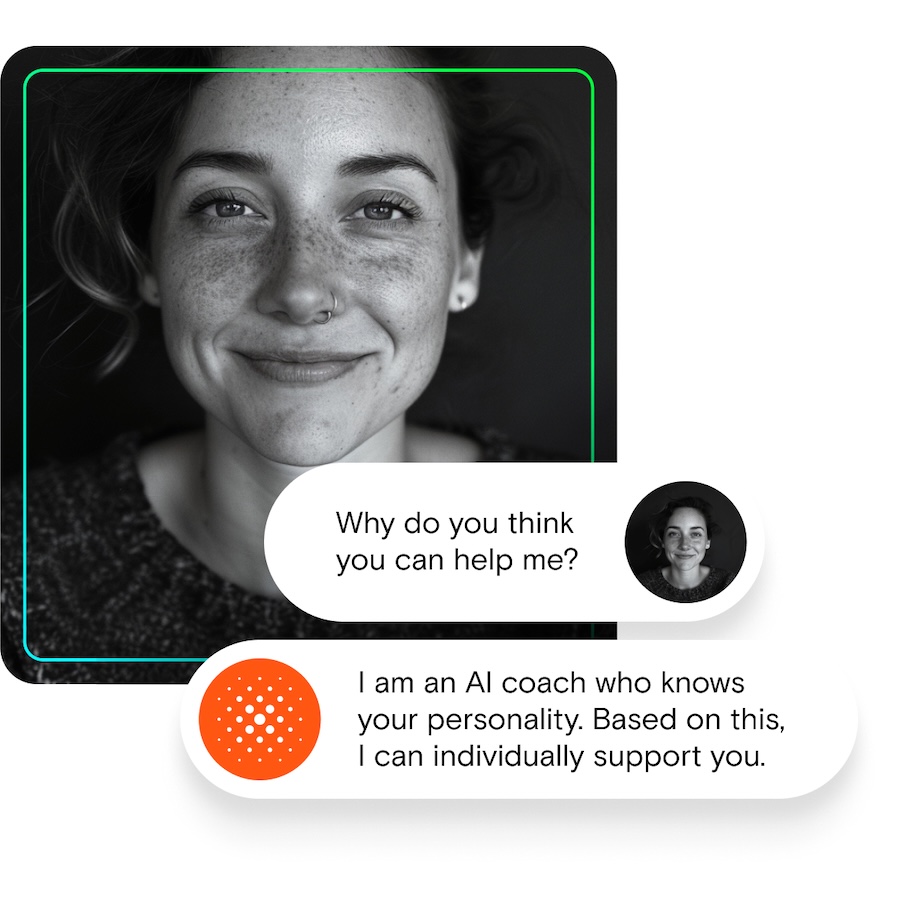
With specialized training and a strong knowledge base in a controlled environment, AI chatbots like Jay by ID37 provide effective support.
AI-powered chatbots are fundamentally transforming coaching and therapy. According to a Harvard Business Review study (2025), therapeutic support is the most common use case for generative AI. The appeal is obvious: AI coaches are available around the clock, come across as empathetic, and are easily accessible. Yet generic AI chatbots carry significant risks – from emotional dependency to a lack of crisis competence. Professional use of AI in coaching requires controlled environments and a scientific foundation.
At a glance:
- According to Harvard Business Review, AI coaching is among the most common use cases for generative AI.
- AI chatbots offer constant availability, personalized responses, and a low barrier to entry.
- Generic AI bots carry risks: emotional dependency, lack of crisis competence, and data privacy issues.
- Responsible use of AI requires specialized development, controlled data, and scientific grounding.
- The ID37 AI coach Jay demonstrates how AI coaching can work professionally and in compliance with GDPR.
Why are more and more people turning to AI chatbots for coaching and therapy?
Because AI chatbots are available around the clock, come across as empathetic, and lower the barrier to discussing sensitive topics. On social media, personality and self-reflection prompts like "What is a truth about me that I need to hear?" or "What is it like to work with me?" are gaining popularity. For many users, AI chatbots serve as a first point of contact for self-reflection – and are even being used as a substitute for therapy.
The Harvard Business Review study "How People Are Really Using Gen AI in 2025" confirms this trend: therapeutic support ranks first among AI use cases, followed by help with life organization and the search for meaning. Users have the need – and no hesitation about turning directly to AI.
What are the benefits of AI coaches?
AI coaches offer three key benefits: constant availability, personalized responses, and practical value. People respond positively to AI-powered coaching for a variety of reasons:
- Constant availability and low barrier to entry: AI coaches are accessible around the clock. Users receive support without having to wait for appointments. No one is afraid to discuss sensitive topics – which makes it easier to seek help with emotional issues.
- Personalized support: AI coaches analyze individual inputs and the conversation history. They adapt their responses so that users feel understood. The eloquence of large language models (LLMs) reinforces trust – it feels human.
- Direct practical value: People who use AI coaches for everyday topics such as reflection, orientation, and finding new solutions receive concrete guidance. Generative AI detects patterns and presents options.
What are the risks of using AI chatbots in therapy and coaching?
Generic AI chatbots cannot fully grasp complex emotional topics and rely on simple patterns. What appears insightful at first glance often turns out to be a standard formula on closer inspection. Uncontrolled use poses serious risks:
- Emotional dependency: The risk of preferring digital conversations over human support.
- Lack of crisis competence: AI cannot provide psychological diagnosis or intervention.
- Data privacy issues: Conversations in generic language models are not protected by confidentiality.
- Cultural bias: Training data is often predominantly Western and may lead to discrimination.
Even though there is a shortage of therapists: generic bots are not designed to treat mental health crises – they can even make them worse. In the United States, investors are backing specially developed therapy AI. The Food and Drug Administration (FDA) grants official licenses for these – subject to very high standards and costs.
What does responsible AI use in coaching look like?
Responsible AI use requires specialized development, controlled environments, and scientific grounding. Anyone who wants to work seriously with AI in coaching needs more than a standard language model. With specialized training and a strong knowledge base, AI chatbots can provide valuable support.
A professional example is Jay, the ID37 AI coach:
- Individual and evidence-based: Jay provides responses based on the user's personal ID37 motive profile. In team settings, he automatically identifies patterns and dynamics between individuals.
- Curated knowledge: Jay does not generate random responses but draws on controlled content from the ID37 knowledge base.
- GDPR-compliant: No data transfer to third parties, no uncontrolled usage, no training with user data. Jay stays within the ID37 ecosystem.
This is how an AI chatbot becomes a trusted coaching assistant.
Can AI chatbots replace coaching or therapy?
No – generic language models can provide impulses, but they cannot replace genuine coaching relationships. Humor, empathy, and personal experience remain fundamentally human. The future lies in a hybrid approach: human expertise combined with purpose-trained AI support.
Discover AI coaching with ID37
ID37 users can try the AI coach Jay free for 14 days in their ID37 account. Everyone else can find an overview on the ID37 product page for AI coach Jay.
Frequently asked questions about AI chatbots in coaching
- Can AI chatbots replace a human coach?
No. Generic AI can provide impulses and support self-reflection, but complex emotional topics, crisis intervention, and genuine empathy remain the domain of human coaches. - What sets the ID37 AI coach Jay apart from generic chatbots?
Jay uses controlled content from the ID37 knowledge base and operates on the basis of individual motive profiles. He is GDPR-compliant and does not transfer data to third parties. - What risks do generic AI chatbots pose in therapy?
Emotional dependency, lack of crisis competence, data privacy issues, and cultural bias. Generic bots are not suitable for treating mental health crises. - What does hybrid coaching with AI mean?
Hybrid coaching combines human expertise with purpose-trained AI support. AI assists with reflection and everyday topics, while the human coach guides complex processes.
Further reading: Discover how AI is used in coaching and self-coaching in practice in the interview How does AI support coaching and self-coaching?.